Plan dirt removal with cubic yards, tons, and truck loads. This calculator applies swell for hauling and helps size dumpster or dump truck tickets.
Quick answer
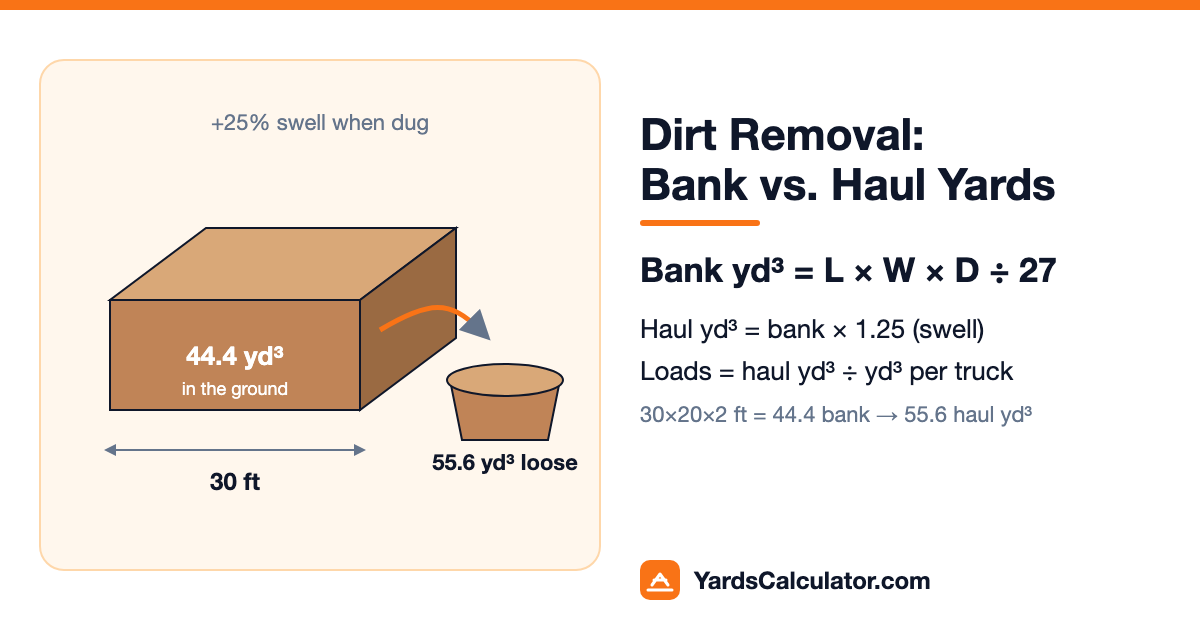
Multiply length × width × depth in feet, then divide by 27 to get bank cubic yards (dirt in place). Add about 25% swell for the loose volume you actually haul, then divide by your truck size (about 10 cu yd for many dump trucks) to get loads.
Example: 30 × 20 ft pad dug 2 ft deep = 1,200 cu ft ÷ 27 = 44.4 bank cu yd → × 1.25 = 55.6 cu yd to haul ≈ 6 truckloads.
Reviewed by Marcus Delaney, Licensed General Contractor (May 2026) · Last updated: October 17, 2026
This haul-off planner turns a cleared pad into bank yards, tons, and truck counts. Pool contractors and grading crews use it before they call the dump truck—especially when the landfill bills by weight, not box size. Plug in your strip area and we'll flag swell so you're not short a load on Friday.
How we calculated this
Convert length, width, and depth to feet first. Then:
Bank cu yd = Length × Width × Depth ÷ 27
Buffer (optional): Adjusted bank = Bank × (1 + Buffer% ÷ 100)
Haul yards with swell on: Haul = Adjusted bank × 1.25 — that's a 25% bulking default for loose load-out.[2]
Tons for the scale: Tons = Yards × tons/yd. Loose spoil often plans around 1.2 t/yd on sand mixes and up near 1.4 t/yd on wet clay.[1]
Worked example: pool deck regrade strip
Last month we stripped a 42 ft × 22 ft zone after demo—6 in of fill came out. Footprint is 924 sq ft; depth is 0.5 ft → 462 cu ft ÷ 27 = 17.1 bank yd. Ten percent buffer → 18.8 yd. At 1.35 t/yd on wet clay ≈ 25 tons—two tandem loads, but the second truck only ran 70% full because of weight.
What affects dirt removal quantities?
Strip depth. Six inches vs twelve on the same footprint doubles export. Measure after sod is off, not from the old grade stake.
Clay vs sand. Clay hits legal weight before the box looks full. You'll pay for tons at the landfill, not friendly cubic yards.[1]
Swell on trucks. Bank yards stay in the cut; trucks haul fluffy yards. Skip swell and you'll book one load too few—that's a Saturday nobody wants.
Gate and route. A 10-yd box doesn't help if the skid steer can't reach the pile. Walk the path before you commit to load count.
Topsoil kept on site. Don't export good topsoil with structural spoil. Stockpile it; your landscape allowance may need it back.
Bank yards are measured in the ground; haul yards include about 25% swell.
Questions & Answers
Do landfills charge by dump truck load or by ton for dirt removal?
Most sites bill by ton with a minimum per trip. Run tons here, then ask if wet clay counts as special waste—fees jump fast.
Why is haul volume bigger than bank yards on a grading job?
Soil bulks in the bucket. Bank is in-place; haul is fluffy. Flip swell on before you schedule trucks.
How many tons fit in a 10-yard dump truck?
Depends on moisture. Sandy spoil might ride at 12–14 tons; wet clay can cap you around 10 tons before the box looks half empty.
Should I rent a dumpster or use dump trucks for backyard spoil?
Tight gates favor walking dumpsters. Open lots with long pushes favor trucks. Same math—match haul yards to the container size.
Can I use this for a long utility trench export?
Yes, but long narrow cuts are easier in our trench calculator if you're pricing spoil per foot of run.
Sources
FHWA — Earthwork construction manual, soil unit-weight ranges used for haul planning.
OSHA 29 CFR 1926 Subpart P — spoil placement and excavation safety on active sites.
Haul-off numbers swing with moisture, clay content, and how full the truck can legally run—confirm tons with your scale house before you lock a price.
How we built this calculator: results use the standard volume, area, and coverage formulas shown on this page, with typical U.S. material densities, bag yields, and waste factors that you can override. Written and checked by the YardsCalculator editorial team. Last reviewed: October 2026.