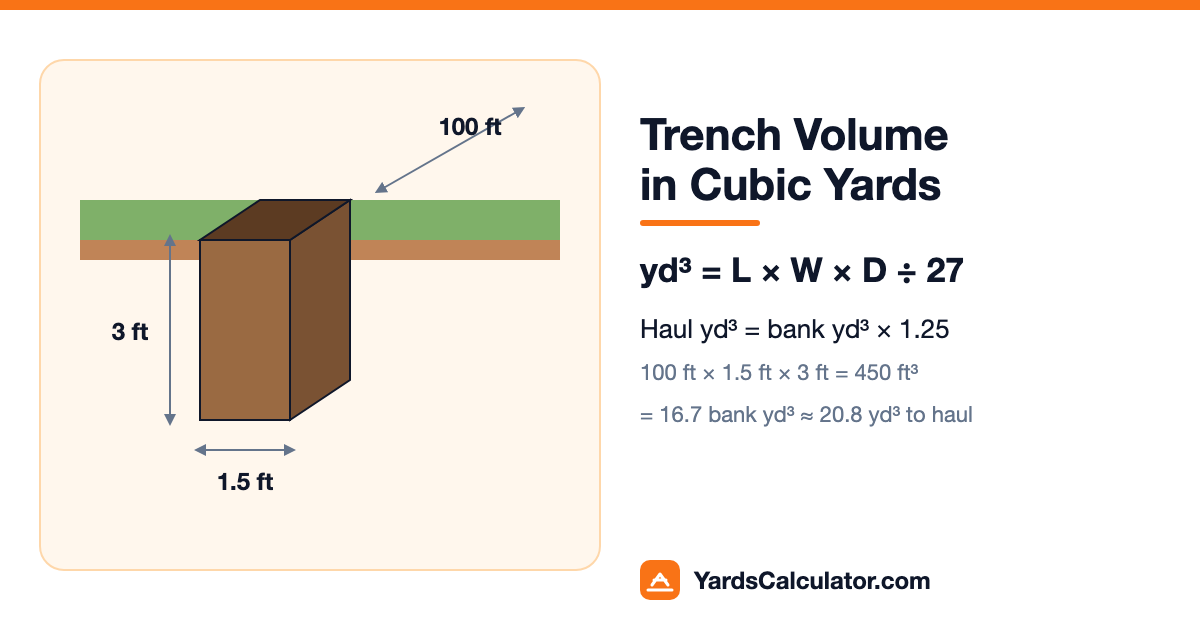
Free trench calculator for utility and drainage trenches. Enter trench length, width, and depth to get cubic yards, cubic feet, and estimated dump truck loads.
Quick answer
Trench volume = length × width × depth in feet ÷ 27 = bank cubic yards of spoil. If the spoil leaves the site, add about 25% swell to size your trucks.
Example: 100 ft long × 1.5 ft wide × 3 ft deep = 450 cu ft ÷ 27 = 16.7 cu yd → × 1.25 ≈ 20.8 cu yd to haul.
Reviewed by Marcus Delaney, Licensed General Contractor (May 2026) · Last updated: October 17, 2026
This trench volume tool prices the hole before you rent the mini excavator. Utility crews punch in run length, bottom width, and depth to invert—then they know how many export trucks to line up. It's a straight prism; if you're benching sides for OSHA, bump width or add buffer.
How we calculated this
Feet in, yards out:
Bank cu yd = Length × Width × Depth ÷ 27
Buffer: Adjusted = Bank × (1 + Buffer% ÷ 100)
Haul with swell: Haul = Adjusted × 1.25 for loose spoil.[2]
Tons: Tons = Yards × tons/yd — sand spoil might ride near 1.2 t/yd; wet trench clay can push 1.4.[1]
Worked example: 88-foot gas service trench
We trenched an 88 ft PE gas run last fall—14 in wide, 48 in to bedding bottom. Math: 88 × 1.17 ft × 4 ft = 411 cu ft ÷ 27 = 15.2 bank yd. Ten percent buffer → 16.7 yd export. Sand spoil at 1.2 t/yd ≈ 20 tons—one tandem plus a pickup on the last trip.
What affects trench excavation quantities?
Bottom width, not bucket width. Inspector cares about clear width at pipe. A 24-in bucket might only leave you 14 in clear—measure what counts.
Invert depth. An extra 6 in on a long sewer run is another truck. Depth is to pipe invert, not grass grade.[2]
Bedding import is separate. You're exporting the whole prism. Sand bedding comes back in—figure that in the backfill calculator, not here.
Frost cover codes. Water in Minnesota isn't the same depth as Texas. Depth drives volume more than width on shallow runs.
Bell holes and fittings. Add pit boxes to length when you have big fittings—field bends eat volume fast.
Trench volume = length × width × depth ÷ 27.
Questions & Answers
How wide is a trench for 1-inch gas pipe with sand bedding?
Often 12–16 in clear at the bottom for small PE—go wider if you're hand-compacting 6-in sand lifts both sides.
Does OSHA require spoil piles set back from a trench edge?
Yes—2 ft minimum setback on unsupported trenches unless your competent person signs off closer.[2]
How do I price bedding sand for the same trench?
This is export cut only. Bedding volume is smaller—use our sand calculator on bedding width × depth × run length.
Should I add swell on a 40-foot electrical run?
Even short runs fluff in the wheel barrow pile. Use swell if you're paying for trucks, not if spoil stays on site.
What if the trench is benched 4 ft deep?
Prism math won't match. Add effective width per bench step or add 10–15% buffer and verify in the field.
Sources
FHWA earthwork references — loose spoil unit weights for planning.
OSHA 29 CFR 1926 Subpart P — trench spoil setback and excavation safety.
Trench volumes shift with slough, benching, and how wet the spoil is—verify truck counts in the field before you guarantee a lump-sum export price.
How we built this calculator: results use the standard volume, area, and coverage formulas shown on this page, with typical U.S. material densities, bag yields, and waste factors that you can override. Written and checked by the YardsCalculator editorial team. Last reviewed: October 2026.